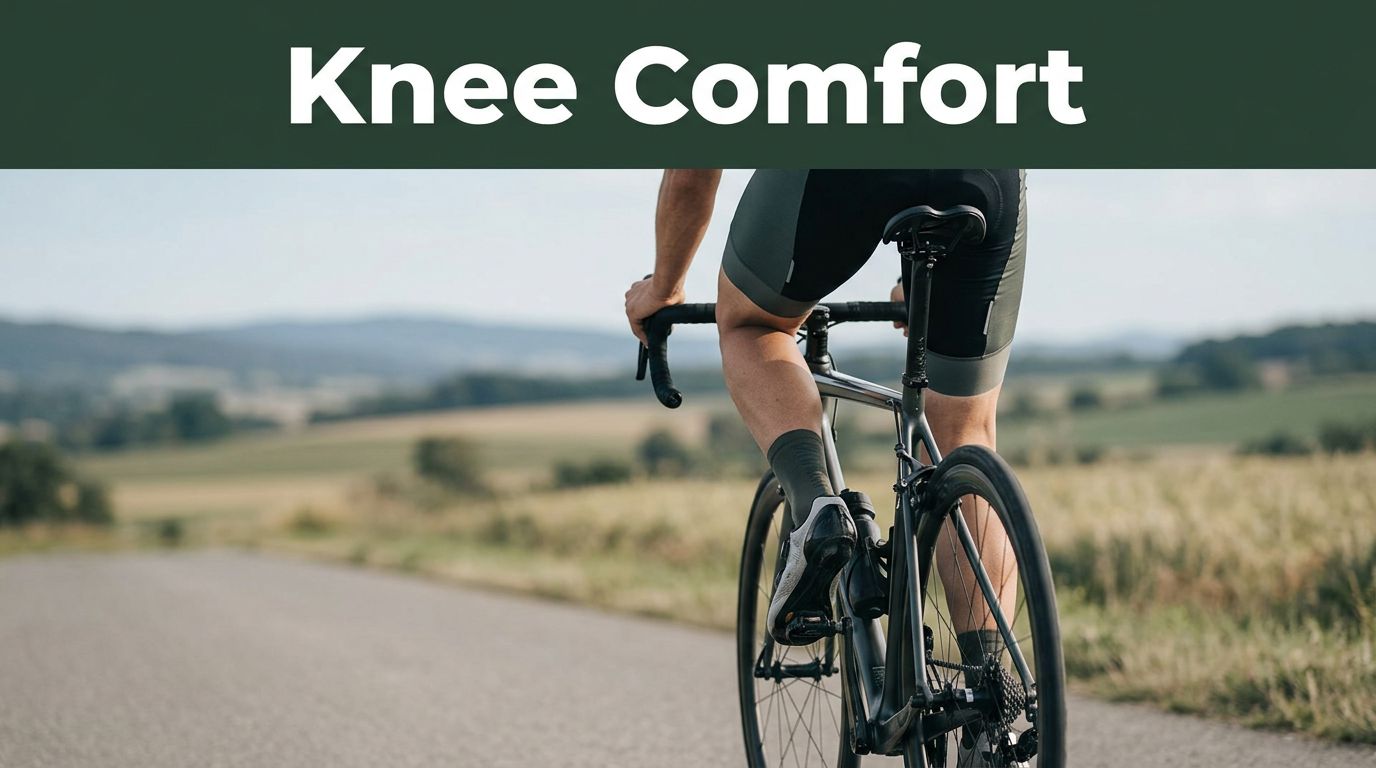
Picture this: you hop on your bike for a routine ride, but halfway through, sharp knee pain hits. It worsens with each pedal stroke. You’ve checked your tires and chain, yet the discomfort lingers.
Saddle height and fore-aft position often cause these issues. They affect how your knees bend and track during rides. Get them right, and pain fades while power increases. This guide walks you through simple steps to adjust your saddle for knee comfort. You’ll learn to spot problems, measure height precisely, set fore-aft balance, and test changes. These tweaks prevent injuries and let you ride longer.
Ready to diagnose your setup? Start by checking common pain signs.
Spot Signs Your Saddle Setup is Causing Knee Pain
Knee pain during rides rarely comes from nowhere. Poor saddle position forces your knees to work wrong. For example, a saddle too high strains the front of your knee like overextending a door hinge.
You might feel sharp pain upfront from hyperextension. Or an ache in the back signals too much bend. Hip rocking or uneven pedaling adds clues. Numb feet or sore hands often stem from knee compensation.
Most fixes need just small shifts. Sound familiar? Use this self-check to pinpoint issues.
- Sharp pain on the front of the knee during push.
- Dull ache behind the knee after long rides.
- Hips wiggle side to side at the pedal bottom.
- Feet go numb or toes tingle.
- One leg feels stronger than the other.
Note when pain starts: climbs, flats, or sprints. Height impacts bend angle. Fore-aft affects tracking. Track these over your next ride.
Front vs. Back Knee Pain and What It Means
Anterior knee pain screams “saddle too high.” Your leg straightens too much at the pedal’s bottom. This hyperextends the joint. Aim for 30-35 degrees knee flexion instead.
Posterior pain means the opposite. A low saddle bends your knee over 40 degrees. It overloads hamstrings and calves.
Imagine a plumb line from your kneecap. At bottom dead center, it should hit near the pedal spindle. Too far forward? Lower the saddle. Too far back? Raise it. Stay in safe ranges to avoid overload.
Other Body Signals to Watch During Rides
High saddles cause hip wiggle as you chase pedals. Quads burn extra from low ones. Calf strain follows too.
Saddle sores or hand pain result from body shifts to ease knees. Watch timing: pain on climbs points to height. Flats highlight fore-aft.
Log these signals. They guide your fixes.
Measure and Adjust Saddle Height for Happy Knees
Height sets your knee’s work range. Wrong setup stresses joints fast. Start with basic tools: tape measure, plumb bob or string, and a bike stand if possible.
Raise or lower in 2-3mm steps. Test after each. Never max out the seatpost; it limits tweaks later.
Ideal knee angle hits 30-35 degrees at bottom stroke. Use a goniometer app or helper for checks. Safety first: secure the bike.
Follow these numbered steps for accuracy.
Step 1: Find Your Inseam and Calculate Height
Stand barefoot against a wall. Slide a thick book between legs at crotch level. Measure floor to book top. That’s your inseam.
Multiply by 0.883 for road bikes. An 80cm inseam gives 70.6cm saddle height from pedal top to saddle top. Add shoe cleat thickness, about 1cm.
Write it down. Mark your post for reference.
Step 2: Check Knee Angle with a Plumb Line
Put pedals at bottom dead center. Pedal backward so crank stays there.
Drop a plumb from your kneecap’s front bump. It should land over pedal spindle or 5-10mm behind. Adjust saddle up or down.
No bounce in your leg? Good. Mirror or phone camera helps solo checks. Fine-tune over short spins.
Plumb line aligns kneecap over pedal spindle for ideal height.
Set Fore-Aft Position to Balance Your Pedal Stroke
Fore-aft slides the saddle front or back on rails. It balances power and comfort. Start with a level saddle; tilt nose down 1-2 degrees max if needed.
KOPS rules for beginners: knee over pedal spindle at 3 o’clock. Modern fits shift it back 10-15mm for hip comfort.
Cleats affect this too; set them neutral first. Adjust in 5mm increments. Proper setup keeps knees tracking straight, dodging side pain.
One rider slid forward 1cm. His knee strain vanished on group rides.
Master the KOPS Method for Starters
Level the saddle. Clip in. Set right pedal at 3 o’clock.
Drop plumb from knee’s bony bump. Adjust till it hits spindle center. Repeat left side.
This method boosts power. But tweak if hips tuck under. It’s simple for home fits.
Advanced Tweaks for Your Riding Style
Sprinters push saddle forward 5mm for leverage. Climbers go back to open hips.
MTB riders with dropper posts prioritize seated position. Check no tucking on hard efforts. Pair with cleat fore-aft for full balance.
Test Adjustments and Troubleshoot Remaining Pain
New setup needs road proof. Ride 10-20 miles on mixed terrain. Warm up 10 minutes easy.
Track knees: pain gone post-warmup? Power steady? Log pre and post notes.
If issues linger, inspect cleats or shoe fit. Wrong saddle width pinches too.
| Pain Type | Likely Fix |
|---|---|
| Front knee | Lower saddle 2-3mm |
| Back knee | Raise saddle 2-3mm |
| Side strain | Adjust fore-aft back |
| Hip rock | Drop height slightly |
Adaptation takes 1-2 weeks. Patience pays off.
Short Rides to Confirm Comfort
Spin easy 5 minutes. Add intervals: 1-minute hard, 2-minute easy.
Rate pain 1-10 before and after. No change? Ride longer tomorrow. Tweak if scores rise.
When to Seek a Professional Bike Fit
Persistent pain, one-sided issues, or failed tweaks signal pros. Asymmetry warns of leg length differences.
Fits cost $100-300. They save doctor visits and lost rides. Go if home changes stall.
Small tweaks transformed that nagging pain into smooth miles. Diagnose symptoms first. Set height with inseam or angle checks. Balance fore-aft via KOPS. Test thoroughly.
Pain-free knees unlock more riding joy. Grab tools tonight. Adjust and spin. Share your before-and-after in comments. Cleat position tweaks help next.
Ride strong.